
Pete Campbell is one of my favourite characters in Mad Men. Not because I like him but precisely on the contrary: I loathe him. He displays an overly sleek, almost slimy, demeanour and holds an egregious sense of entitled privilege and misogyny, those most classical of patriarchal pairings. In fact he is practically an icon of masculine entitlement.
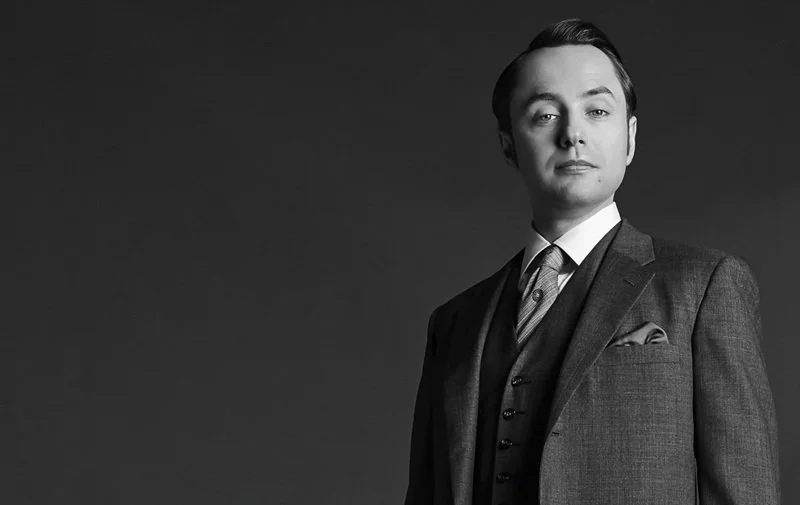
Peter Campbell, portrayed with exquisite brittleness by Vincent Kartheiser, exuding all the airs of his imperious pomp. Truly, as we shall see, an example of a smug backpfeifengesicht par excellence. Image: AMC
In the very first episode of the show, in the first scene he is the centre of, he pretty much spells out his attitude when he responds to his then-fiancée Trudy’s suggestion that he isn’t committed enough to the relationship. He pithily replies
I’m giving my life up for you, aren’t I?
The other men in the room offer conciliatory nods and the general vibe is one of a kind of resigned obligation. That this is just the way things are and she should be quite grateful for such a chivalric submission to the whims of a mere woman.
And this is just the tip of the iceberg. In that same first episode he objectifies Peggy on her first day at Sterling Cooper and later tries to feel up a girl at a strip club. In later seasons he pathetically hits on a teenager who is still in high school, while he himself is only just learning how to drive as an adult (which, incidentally, didn’t stop him crashing a Chevy in a showroom a few seasons later). Pete accidentally runs into his father-in-law in a brothel, establishing a bond of mutual shame. He helps a neighbour’s au pair, a young German who is unfamiliar with New York, to have her dress repaired—and then feels entitled to sex merely for having been such a “nice guy” about it. His subsequent coercion makes for uncomfortable viewing. When he staggers his way to Peggy’s apartment in season one, barely understanding why he is there, he fittingly says
You must think I’m a creep.
Yes, Pete. Yes, we do. Yet Campbell also frequently acts as the show’s comedic relief in many respects; it frequently punishes his many hypocrisies and double standards with a good verbal kicking—from Don Draper and Roger Sterling in particular. It was with considerable joy that I watched Lane box his face just like he deserved. It is his overarching narrative function to be a foil and irritant. His frequent lecherous advances (not unusual for the show, but unusually pathetic in many cases), his infantile fury at being denied what he wants, and his inability to see himself as others do are all hallmarks of his fundamental character. Pete Campbell is not easy to like.
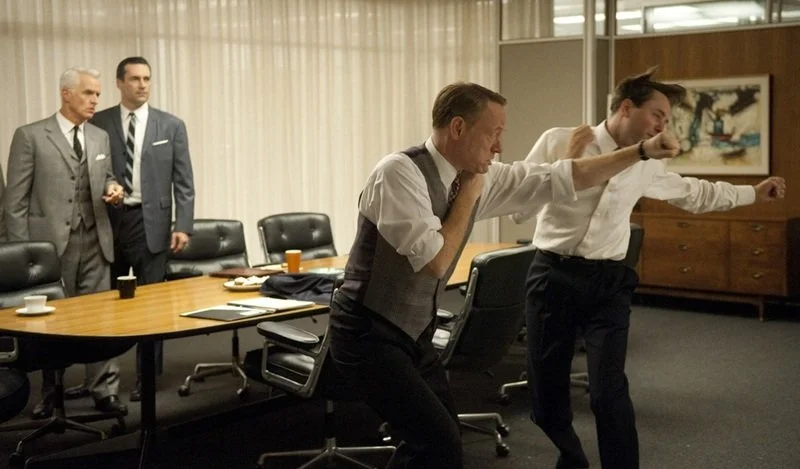
Lane getting to do what we’ve all thought about doing. Roger Sterling, on the far left, says in classic style: “I know that cooler heads should prevail but am I the only one who wants to see this?” Image: AMC
And yet there is an aspect to Campbell’s character which is not so straight forward, and an arc he follows which is ultimately surprising in both its resolution of Pete’s many internalised grudges as well as a meta-commentary on the nature of identity itself. While he might not be easy to like, he is easy to watch.
Many Unhappy Returns
Pete spends much of the early seasons fixated on truly trivial nonsense. In an early episode called Red in the Face, he and Trudy receive a pair of feminine chip and dip trays (flowery concave bowls which in multiple ways symbolise female genitalia or sexuality), which quickly become an obsession of his because they seem to reflect the way other people see him. Not just one leafy, feminine dip platter, but two. That’s no coincidence apparently. He takes great pains to reinforce this to anyone he speaks to.
It was a gift. We got two.
It was a gift. They got two. His need to return this metaphorical female sex organ to the store from whence it came is clear, and his chosen replacement is a comically phallic substitute in the form of a rifle. It’s honestly hilarious. He feels entitled enough to exchange a wedding gift—presumably something which should have benefited both he and Trudy—with an object designed to satisfy nothing more than his own fragile ego. The gun, made for hunting, is especially useless in the concrete jungle of Manhattan.
To be fair, it could be argued that Pete didn’t go into the store with the specific intent of exchanging the dip for a gun: he was lured into it by his own broiling envy and insecurity. He runs into an old college friend and becomes predictably jealous of the attention Matherton effortlessly receives from the pretty exchange clerk he himself had been working hard to maintain. When Matherton swans in and she shifts her focus to him immediately, Pete visibly seethes.
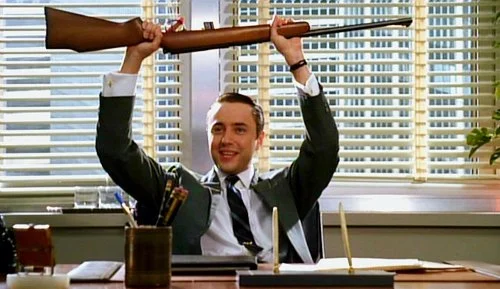
Pete Campbell, Tusken Raider. Image: AMC
It’s amusing to me that as Pete is later waving his phal—I mean, gun around and aiming it at various people in the office he says something along the lines of it being “good to 20 yards”. In the very next episode, when he and Peggy have sex (also in the office), he mentions how hard it is for him to work with her only being 20 yards away. It’s certainly one of the less subtle metaphors in the show.
The very obvious emasculation he experiences, repeatedly, is reinforced by Trudy’s anger at not being included in the conversation about what might replace the chip-and-dip. It has the air of a regular marital argument, but the framing of the scene and the context of his behaviour is telling.
You go and get some stupid toy—I can’t believe you! That was for us! You’re always telling me to grow up—I can’t believe you!
Alison Brie’s pitch-perfect Trudy deploys the perfect amount of shrill, all the while Pete sits despondently in his chair taking his licks with the ludicrous weapon straddled across his legs, staring dejectedly into the distance. The scene ties a tidy private knot at the opposite end of the public swagger he displays at work, delighting that it’s the “same price as a chip-and-dip” as he thrusts the rifle above his head triumphantly with both hands.
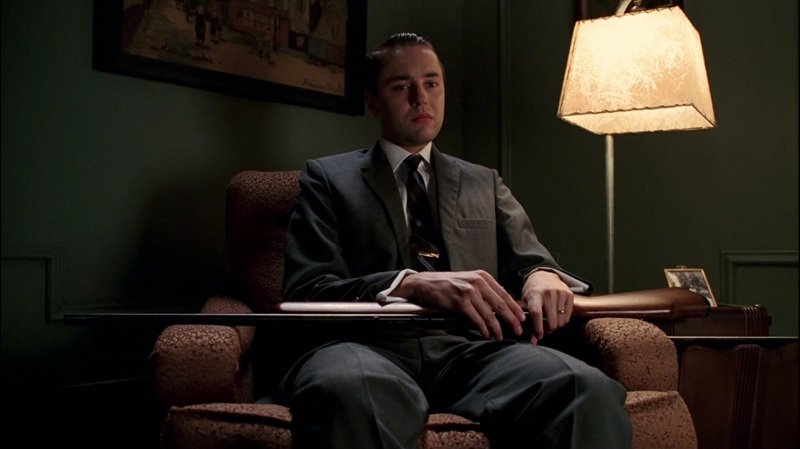
Pete, in shadow and gloom, with Trudy unseen and her lecture only heard from off-screen. The lighting here is quite ominous; Pete is comfortable in his chair with his comfortable life but his despondent face tells us he is anything but comfortable here. Now that he is forced into some accountability, the gun doesn’t seem so fun. Image: AMC
Trudy’s annoyance is perfectly understandable, except from Pete’s perspective it seems like he can no longer even express his own masculinity without his wife’s permission, which is why the rifle ends up becoming a symbol of his impotence. Let’s not forget that Pete endures several other explicitly emasculating scenes, such as when in season five Don Draper competently fixes the kitchen sink at a dinner party, and with ease, to the very obvious enjoyment of the women present. The dripping sink was a problem Pete himself caused but could not fix. Cucked, as one might anachronistically say, at every turn.
Never mind that by season seven Don, approaching his own nadir, cannot even fix his own broken sliding door and sits shivering in the cold rather than seek help. It is no coincidence that he is alone, without anyone present to get approval from—there’s nobody to fix the door for, and it’s not worth him doing it just for himself. Campbell isn’t the only one who has no idea why he is so miserable.
But the tap-fixing episode isn’t about Don at all; the drip which caused the problem in the first place—which Pete does little more than superficially tinker with—is a symbol of his anxiety. It represents all the nagging, irritating things he can’t fix about his life. It foreshadows the need for a turning point in his life—which the rest of that episode, called Signal 30, with its driving school, office fisticuffs, and kitchen sink situation, certainly drives him toward against his will. At his own dinner party—a thinly veiled effort at showing off all his accoutrements: his house; his wife; his stuff—he is overshadowed both by Don’s natural dominance and even Ken Cosgrove’s artistic fulfilment. Ken is humble enough to deflect, but his wife insists on gushing about it. After his brawl with Lane, Pete turns to Don in the lift, his face covered in bruising, and says “I have nothing, Don.” It’s grim. And, of course, untrue—Pete is just feeling particularly sorry for himself.
That Pete is so hopelessly clueless about what really irks him, what his true desires really are, and how much he lets emasculating intrusions get under his skin, is a large part of the joy of watching his character. Campbell is so insufferable that his own suffering is appealing, up to a point. He is so often frustrated and downright offended by petty challenges to his status and so puerile in response to them that we as viewers can’t help but be amused by his pain.
A Scion By Any Other Name
In season two we discover that Pete is a kind of nepo-baby from a prestigious and presumably very wealthy family, though it isn’t his father’s money he benefits from: his mother is an heiress and it is her fortune which guarantees his future (at one point Bert shields Pete from disciplinary action because he doesn’t want word to get out about Sterling Cooper within those circles).
Yet, it is not to his mother but to his father he must turn to ask for money and at whose feet he must grovel for favour. His mother is a largely passive, diminished figure who he sees more as a burden than an authority figure or role model. It is no surprise that Pete Campbell has an tenuous and highly insecure relationship with masculinity surrounded as he is by lecherous, domineering bullies who he struggles to emulate, and yet it is interesting that he actually tends to gravitate quite strong women—most notably Trudy and Peggy.
He resents his father, but one gets the sense it isn’t entirely on principle; he seems to have a powerful Oedipal distaste for his old man, resenting the power his father wields over him specifically, not necessarily that he is wielding power unjustly unto itself. That is, Pete is more annoyed that he had to humble himself in the first place than that his father actually said no. It interferes with his plans and his pride. In response, his father says to him
We gave you everything—we gave you your name. What have you done with it?
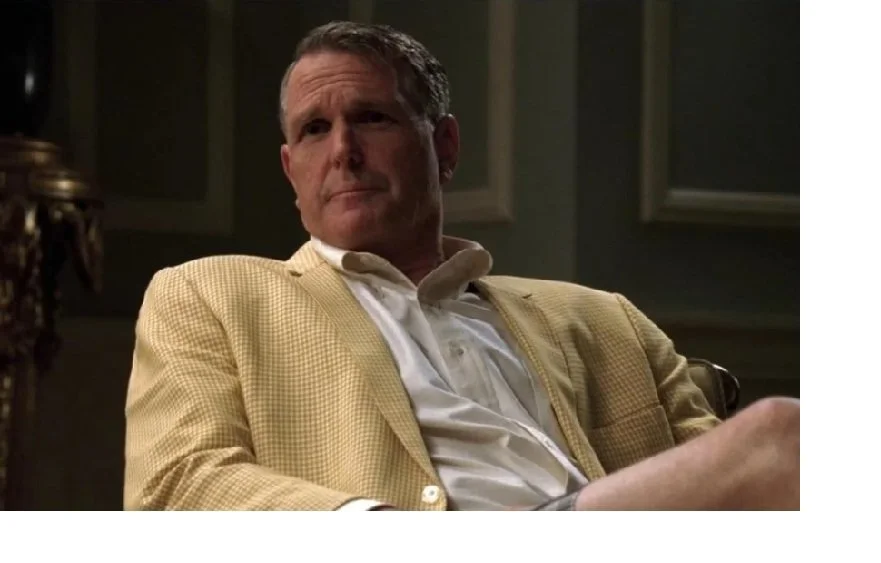
You can just imagine how blue the blood would run if he cut himself shaving. This is some wonderful costume design: Pete’s father is given shorts to go with that awful jacket, and displays not an ounce of shame. It’s the sort of tastelessly pompous naff which only someone who can afford, both literally and metaphorically speaking, to spend all their energy on such a gauche display of status, might actually wear in public with a straight face. At least to whatever bullshit country club he was probably on his way to.
Never forget: this guy got all his money from his wife, her trust fund, and blew it all. And still had the nerve to act superior to everyone else. At this level of obscene wealth, only image matters; reality is something to worry about another time. Image: AMC
And so it is that the familiar reek of entitlement settles in here; it becomes obvious where Peter gets it from. His father thinks that the greatest gift he can give his son is the family name. Not a resource like money or, heaven forbid, love or attention or acknowledgement. In his father’s view, the most important thing a family can provide is its hereditary entitlement. A name. So it is hard not to see that this attitude is exactly what was passed on to Pete; he is very much a product of his family environment.
After he swallows his pride and asks for money (for a down-payment on the expensive apartment Trudy expects them to be able to afford), he is rebuffed.
Pete then expresses a kind of petulant rebellion in perhaps the only way he knows how. His mother carefully placed his drink on a coaster, and he gulps it down and then just drops it back on the table next to the coaster; take that, old man. Such obvious disdain in such a small gesture. After all, he is in a house almost literally wrapped in drapes as the elder Campbells are about to be off on some holiday somewhere, as his father’s atrocious attire suggests.
The tragedy, and irony, of this particular situation is that when his father dies unexpectedly in a plane accident, Pete and his brother discover that their family wealth—this great and important thing—has been squandered by their father’s opulent lifestyle. That is, Peter’s own father has lived a life of extraordinary privilege, lorded his wealth over his two sons, and yet behind closed doors has wasted it all. Only once he is dead is it made clear to the boys that there will be no inheritance at all. And worse: they still have an upper-crust, genuinely blue-blooded mother to look after in her old age.
There’s an unlearned lesson here for Campbell’s befuddled mother, who simply cannot comprehend where all the money has gone: neither of her sons are keen to spell it out to her. Here is a man who appears to be one thing—a grandiose and looming patriarch reticent to dole out money to indolent and undeserving offspring—and yet not only was he the one to waste it and leave everyone else bereft, this great wealth he prided himself in came from his wife’s estate. It wasn’t even his to spend—though in the course of these things, in a capitalist patriarchy it certainly became so eventually.
It is easy to imagine that Pete’s father bristled so much, and was so difficult to squeeze money out of, precisely because he knew darn well he had no money left to give. What little motivation or urge he may have had was crushed by the necessities of a secret guilt and shame, the underlying engine driving an outward demeanour of intractable masculinity. Instead, he doubled down on his pride and just ignored the reality of his family’s impending impoverishment.
The illusion of his power, founded upon deception and entitlement, was shattered the moment he died and the truth—by cruel necessity—was revealed. And therein lies the tragedy: a hubristic disregard for the real situation—his squandering of the family fortune—a refusal to admit responsibility; a complete descent into temptation; an indulgence of pride in the face of reality.
Lessons Unlearned
Pete himself learns nothing from it. Or, perhaps more accurately, the lesson he takes from the situation only reinforces his existing sense of entitlement. He continues to bleat and moan about his lost inheritance rather than take a renewed care for the welfare of his brother and mother, who fade into the background of his priorities behind his colossal resentment.
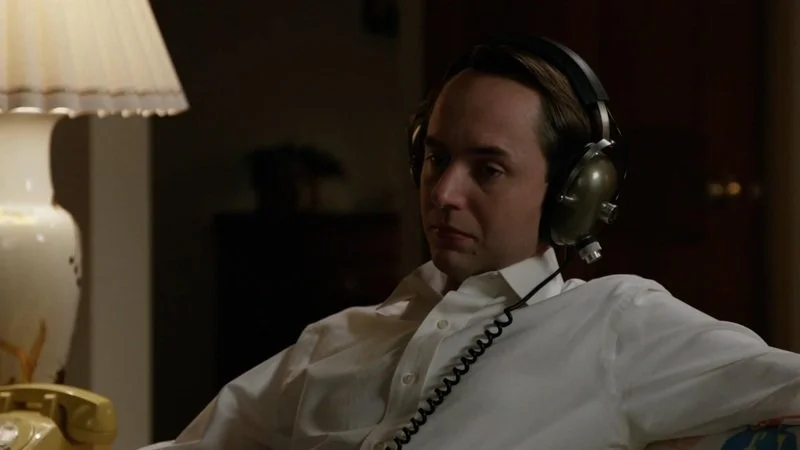
Campbell listens to yet another Man Men podcast expounding on how good the show is, what a terrible and heartbreaking antihero Don Draper was, the empowerment of Peggy Olson, Roger Sterling’s best quips, the many fascinating aspects of Joan Holloway, the qualities of the ending… and yet so little mention of poor Pete and his many struggles. Image: AMC
And so it is easy to see how much he mirrors the father he loathes so much: Pete has the pedigree but he doesn’t have the money. All he has is the name. In later seasons, it’s Trudy’s family via her father who have all the money. Pete himself is on a decent salary but the really big dollars they seem to anticipate and expect come from her dowry, not Campbell or his inheritance—which of course is essentially nothing. He really is just like his father.
Pete complains regularly throughout the series how things aren’t fair, even though he has lived an incredibly comfortable and privileged life. Things only aren’t fair in relation to the expectations which were set for him in childhood. He does not stop to think about how that childhood, ipso facto his having coming into it by pure chance, was also unfair. He is utterly blind to his privilege, and can only see the things he desires which he still does not have—many of them inappropriate or even ludicrous—and cannot imagine others looking upon him in the same way he looks upon them.
In other words, his entire personhood is driven by envy.
An argument for one of the low points for his character might be when he discovers he has had a child with Peggy. At first, he expresses pure surprise, as one likely would. The shock of it certainly affects him, though it seems to have little impact on his behaviour in the short term. Yet that moment is perhaps a catalyst for stirrings of regret—which, while they initially manifest as resentment, eventually become something different.
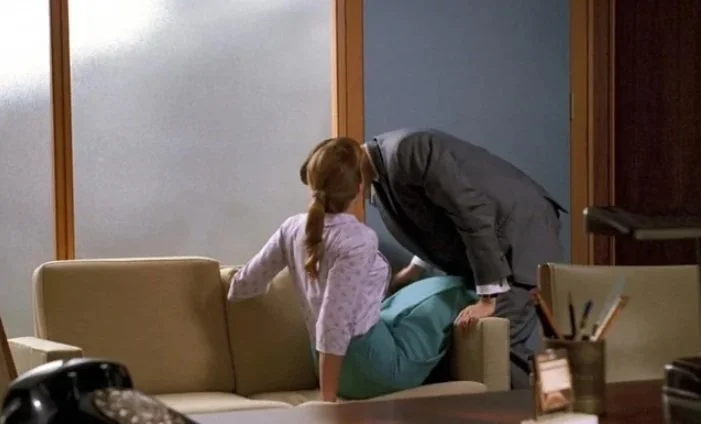
A lot of action happens on this couch. Not just this early morning dalliance early in season one, but their later heart-to-heart as well. In fact, quite a few key connective moments between Peggy and Pete happen on a couch. Image: AMC
Pete professes his love for Peggy in the same scene, responding quite sincerely (for Pete) to her earlier suggestion that he be more honest. In fairness, his bumbling efforts to express himself are his attempt to be just that: more honest. Yet even in this moment he cannot help but feel sorry for himself. He miserably tells Peggy that while Trudy would care if he was gone, “she doesn’t know me—but you do”. And then she quite courageously rejects him, alluding to the fact that she could have used their child—out of wedlock—to manipulate or even force him into being a part of her life.
I love you, and I want to be with you. What… didn’t you know that?
Pete… I could have had you in my life forever if I wanted to.
What do you mean?
I could have had you… I could have shamed you into being with me. But I didn’t want to.
By this stage, Peggy is already engaged in her own process of self-determination. She speaks the truth to him even though it hurts him. Figuratively she is the opposite of his father; her integrity demands honesty, even if it is unpleasant. When she then confesses with great discomfort that they had a child together, Pete’s indignant response is “why would you tell me that?” and he thinks, as usual, only about himself. By doing so his misery is compounded.
It’s seems like a deserved punishment, or comeuppance, though it also feels utterly insufficient in comparison with his variegated cruelties. Peggy even gives him a reason: “I wanted other things.” That’s precisely how she knows she wants other things than him. Her reply holds no malice, either. Unlike Pete’s many cheap shots, which are laced with his inherent vindictiveness.
On Endless Re-Pete
Pete Campbell represents in all of these examples the ways in which a great many men engage with masculine privileges in particular. That is, such privileges are both subconsciously presumed and reinforced even as they are explicitly protested. How hard it is, to be a man constantly reminded of all this privilege—it’s not fair, I have it hard too; I just can’t understand what the big deal is.
To be so incognisant to one’s own inherent advantages in the very same moment as one bitches and moans about how hard things are would be hubristic if such men weren’t also, and tragically, utterly oblivious to it. This is why so many characters in the show, and the audience itself, finds Pete so repulsive. Don Draper says to him in the very first episode:
Keep it up, and even if you do get my job, you’ll never run this place. You’ll die in that corner office, a mid-level executive with a little bit of hair that women go home with out of pity. Do you know why? Because no one will like you.
Don can see that Pete is not made of the same stuff as him. And boy is he right about that, in more ways than one. He plays to all of Pete’s insecurities here: you are already in second place; you aren’t good enough; you will never have power; you are miserable; you are unattractive. In other words, you have no real social status. Don’s insights into insecurity wound like a lance precisely because he is so familiar with them himself.
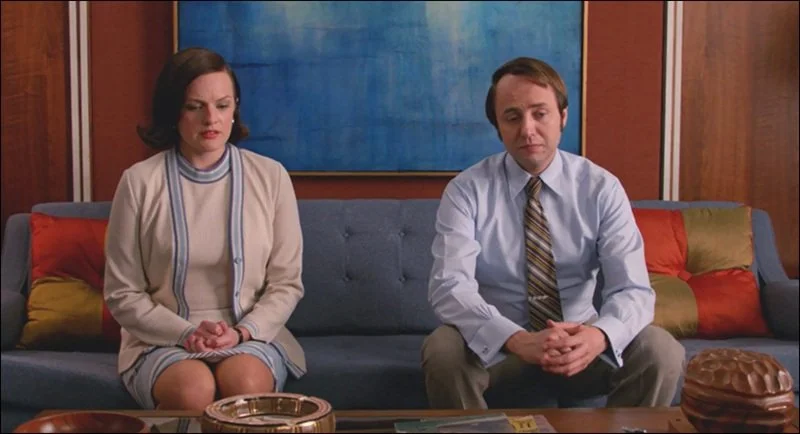
Yet another couch. Image: AMC
These are not new problems. There’s a particular relevance to Pete Campbell’s general attitude which pervades contemporary discourse around things like the purported male loneliness epidemic or crisis of masculinity; take your pick. They all refer to the same thing: men being exploited by other men and, blinded by their own jealousy and entitlement, seek to blame others rather than thinking about how they might improve themselves. Because that means setting aside the scapegoats and the anger and getting to know the Self.
The sad reality is that feelings of emasculation and lack of worth are regularly and ruthlessly exploited by other men, not in order to functionally aid or assist their brothers to overcome such feelings of wretchedness (as their deceptive façades almost universally advertise). Instead, they actively exploit those same vulnerabilities, the ones they pretend to have a solution for. That’s how patriarchy works, and Don’s doing it here, too.
Full Circles
And yet in a bizarre but, mercifully, not overly sentimentalised twist of fate (one which might only exist in what was surely a golden age of television come and thoroughly gone), Pete and Trudy end up with something of a happy ending. There’s a phase beginning late in season six where Pete seems to ruminate on his life, and show a form of genuine contrition for his past behaviour.
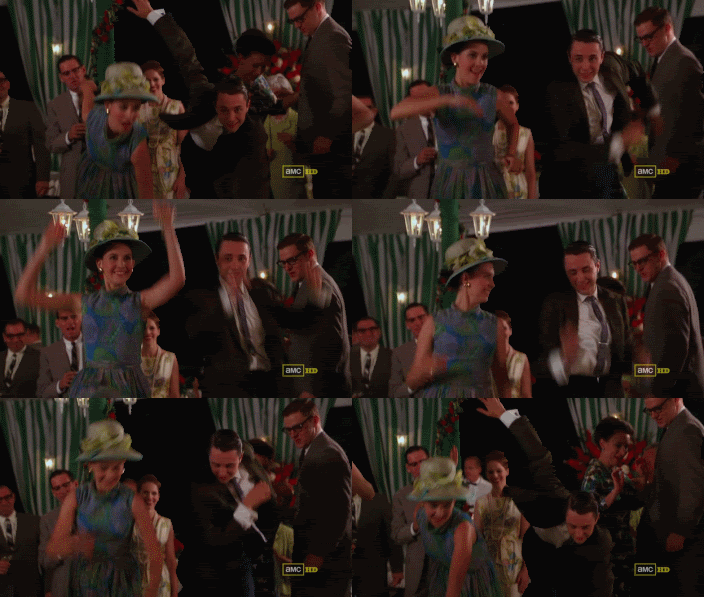
Pete and Trudy, it’s easy to forget, are wonderful dancers. They pull off an impromptu performance which literally holds everyone around them in thrall. It’s something of a power move, really, and signals a change in the nature of Pete’s relationship with his work and makes him—in a rare mirror of the usual juxtaposition—a figure of envy for other characters.
But critically it is also a moment when Pete, in particular, is just being himself, and both he and Trudy display an unfiltered joy in their dancing together. It’s almost, but not quite, a harbinger of things to come. Perhaps if Pete were a less messy character this symbolism might seem cleaner, but that’s the whole pleasure of the character.
It also shouldn’t be forgotten that these two with their energetic (if old-fashioned) dance moves are clearly shown in that same episode to be in direct opposition to Roger Sterling and his appalling black-face serenade. Image: AMC
At first, given how shallow he is and especially given what we’ve been conditioned to feel about the remorse of men in the show (via Don Draper in particular), Pete’s initial apologies to Trudy come across as superficial. Just more of the same: say sorry, do a bit of gaslighting, hope it blows over. Repeat. But contrary to all expectations it turns out that Pete does genuinely seem to want to better himself.
And things don’t immediately turn around for him either. He has to work on it, and despite her instinctual compassion, Trudy is clear-sighted and doesn’t give anything up easily. While they are reconciled by the end of the show, they are not remarried and remain divorced.
Pete later confesses to Peggy in an echo of his earlier reaction on the couch in his office that she is the person who knows him the best. Yet this time around, in doing so he acknowledges the worst of himself. Because she’s seen it. She has borne the brunt of it. The nadir of his cruelty can be observed back in season one during his jealous observation of Peggy dancing with other guys at a bar—when she approaches him to join her he snaps, “I don’t like you like this” with all its shame-filled insinuations.
Her heartbroken retreat, as she struggles to hold back tears, is hard to watch. Her only mistake was to shatter the illusion he had of her as a particular kind of fantasy; being a real person with real desires wasn’t actually what he wanted at all.
Fast forward again to season six and the two of them are drinking together. He has lost a large degree of his bitterness and the two of them seem to genuinely respect one another as co-workers.
Please tell me you don’t pity me.
I don’t.
Because you really know me.
I do.
The moment speaks volumes not just because of its similarity to a matrimonial declaration but because Pete is beginning to understand who he is, where he has come from, and gather some independent dignity which he can keep just for himself. That’s why he doesn’t want pity. Because of the experiences (not least the abandoned child) they share, Peggy is the person he needs most to recognise how he has changed, and to see the person he has become. The scene is quite moving, not just for Peggy’s capacity for forgiveness but for Pete’s ability to show genuine humility. And in doing so generate some self-respect.
Pete has a fondness for old-fashioned statements—hell’s bells, Trudy!—probably because of his upper-class upbringing and his generational position, and he often seems oddly out of touch with his own times, especially as he gets older. But one recurrent statement he deploys—not quite a catchphrase but it’s not far off—is “a thing like that”. It’s usually used reflexively, in the sense that he probably isn’t paying requisite attention to what’s happening or isn’t even sure what to say, but it is distinctly Pete. It’s filler, for when he just wants to say something… anything, to fill an awkward space. It’s likely comparable in contemporary parlance to simply saying, “nice”.
Nobody else in the show uses it, with a single exception. And this exception also extends to its meaning and weight, too. For the first and last time it is used in a genuinely emphatic way, even though the line is delivered very softly.
In the final season, Pete manages to invert his typical need for validation and offer Peggy what for him is likely the ultimate compliment. It lands so well because he is being completely honest when he tells her, along with an appreciative iteration of “a thing like that”. Its repaid in kind after he says to her
Someday people are going to brag that they worked with you.
What am I supposed to say to that?
I don’t know. No one’s ever said it to me.
A thing like that.
I mean… what a show. To end up feeling some kind of sympathy and fondness for Pete Campbell of all people. What a way to wait—until literally the last minute—to have his otherwise throwaway line used so effectively. Whilst not shying away from all his entitlement, insecurity and, as a natural consequence, arrogance, the show still makes space for him. To reflect, sit with his guilt and shame, and eventually come around to being a better husband and father and friend (if even only a bit better; nobody expects he has become some kind of hero). It’s quite an arc.
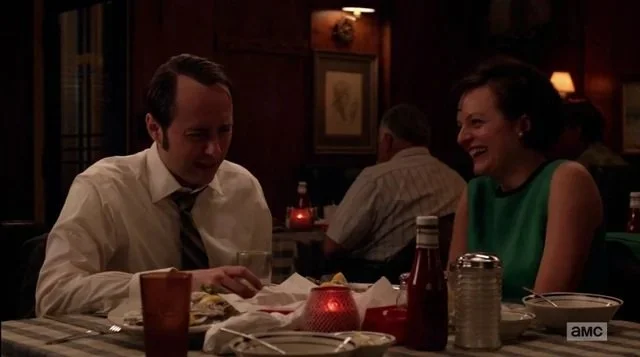
Pete and Peg share a laugh; for once, not on a couch. Their interaction bears more than a striking resemblance to a declaration of marriage. It represents the fulfilment of their long-grown respect for one another. Image: AMC
Now, don’t get me wrong; I will always reflexively squirm at the mere mention of his name and his baby weasel face and gag at the stink of his entitlement. But I’ll squirm with a smirk on my face. Mad Men is like few other shows in its ability to affect nuance and multiplicity of agenda and variegation of delusion within each of its characters and Pete is no exception. He is a three-dimensional figure within a show full of them.
And yet, Don’s earlier prognostication isn’t entirely incorrect, either. Pete remains, by the end, a mid-level executive with little hair—he becomes progressively more bald as the show goes on—but his one saving grace is his ability to remove himself from a fantasy ideation of himself into a realistic one. In doing so, he also critically escapes his inferiority complex.
A Thing Like That
In my view, the larger inference the show is making with the character of Pete Campbell is that his arc is not really about any kind of redemption but about separating his identity—replete with its emasculation and resentment—from that of his image of Don Draper, who he admires and resents in equal measure. Don dominates Pete at every chance (which is precisely what Pete reveres and envies about him), and it’s only that he stumbles across the truth about Dick Whitman that he has any influence over Don at all.
He wants to be like Don, but doesn’t realise that Don is a literal façade, a fantasy, a simulacra of who he appears to be. Even Don isn’t actually Don. As Pete comes to gradually realise this, albeit not until those latter seasons, he steps into his own self and recognises—for himself—what kind of man he is and has been and as an extension of that starts to imagine who he wants to be. And within that acceptance he finds some peace. This is the slow recognition which he shares with Peggy, who is perhaps the one person in his life who might truly see it: she knows his worst, and so she can see his best, and they share that moment with a kind of platonic affection which arguably transcends any other form of love in the show.
And so he comes to terms with Pete the husband and father, moving away from the big city instead of trying to be a doppelganger of a simulation, dying in that corner office in a fancy New York ad company building as the bald, pitiable arsehole nobody likes.